You've read dozens of papers. You still don't have a research question.
Find one focused, literature-backed candidate research question in 7 days, with a three-step method: find the gap, formulate the question, pressure-test it.
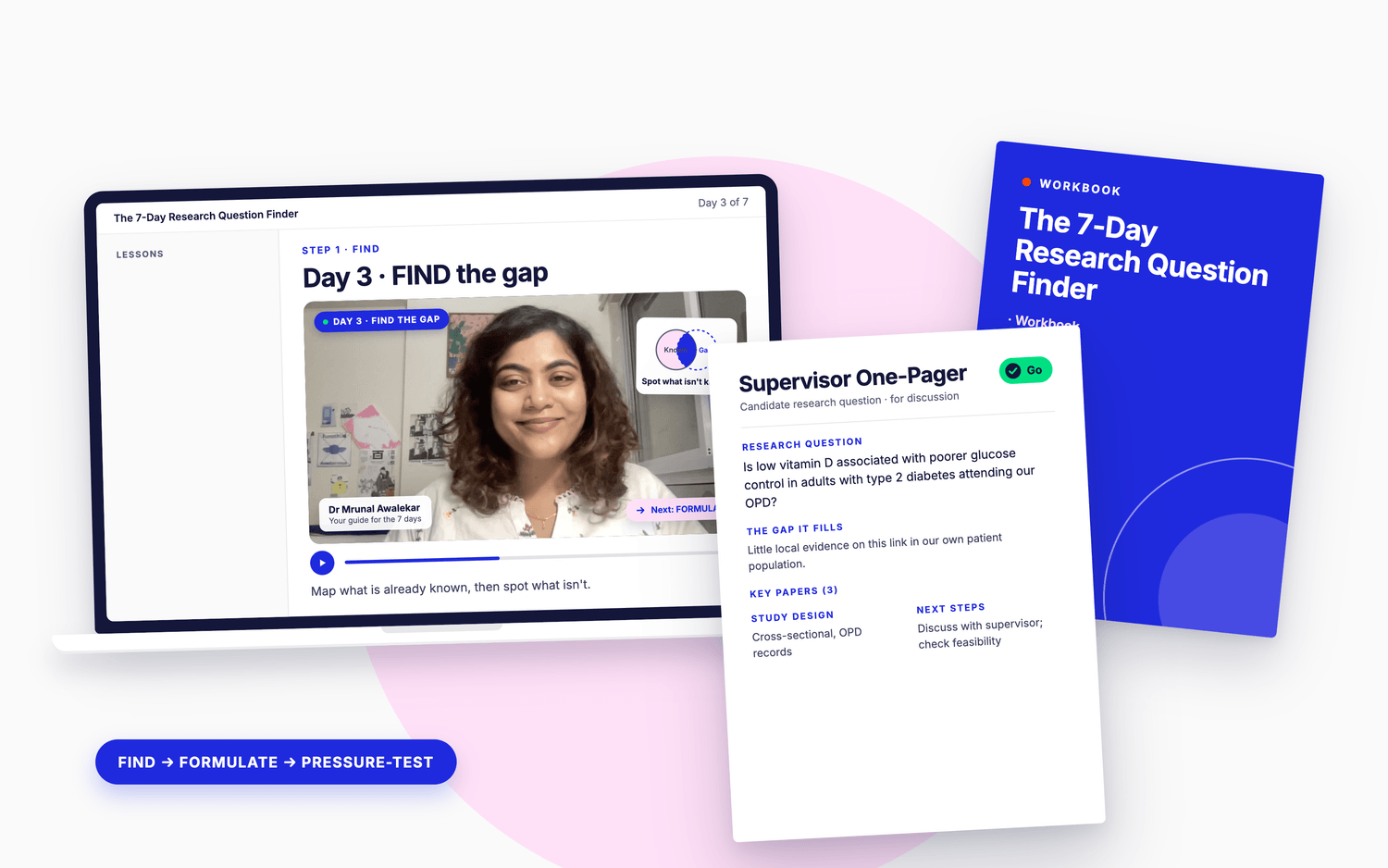
Taught by Dr. Mrunal Awalekar · MCh Surgical Gastroenterology (Gold Medal)
In 7 days, you walk into your supervisor's office with this.
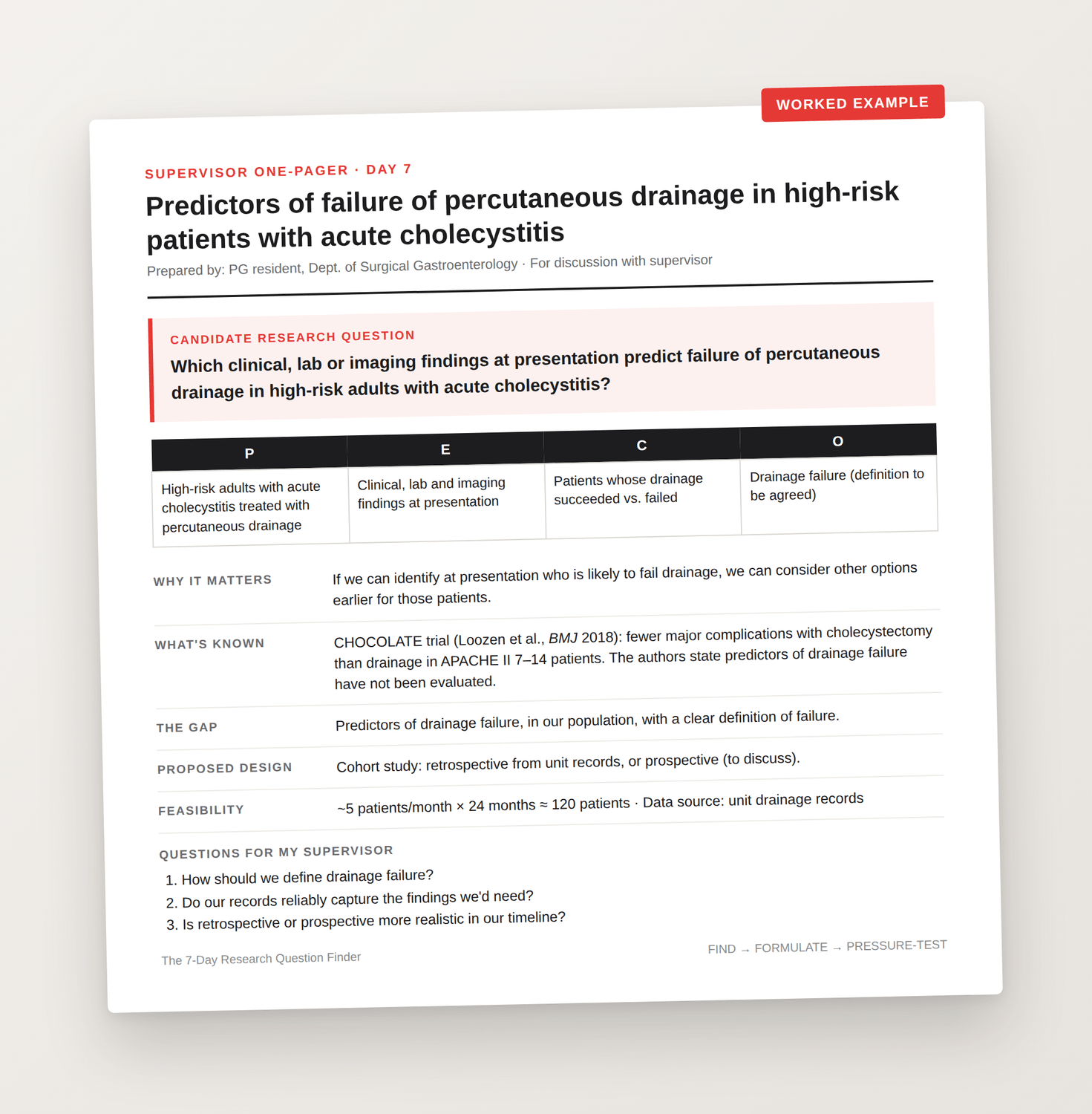
One focused, literature-backed candidate research question, with the gap it fills, the papers behind it and a feasible study design, on one page. It isn't a publication or a guaranteed approval. It's the step before those, and it's where most people get stuck.
Does this sound familiar?
You know you need to do research. You just don't know what to research.
You've saved 40 PDFs and opened 30 tabs, and you're no closer to a question.
Every idea you have feels like it's already been done.
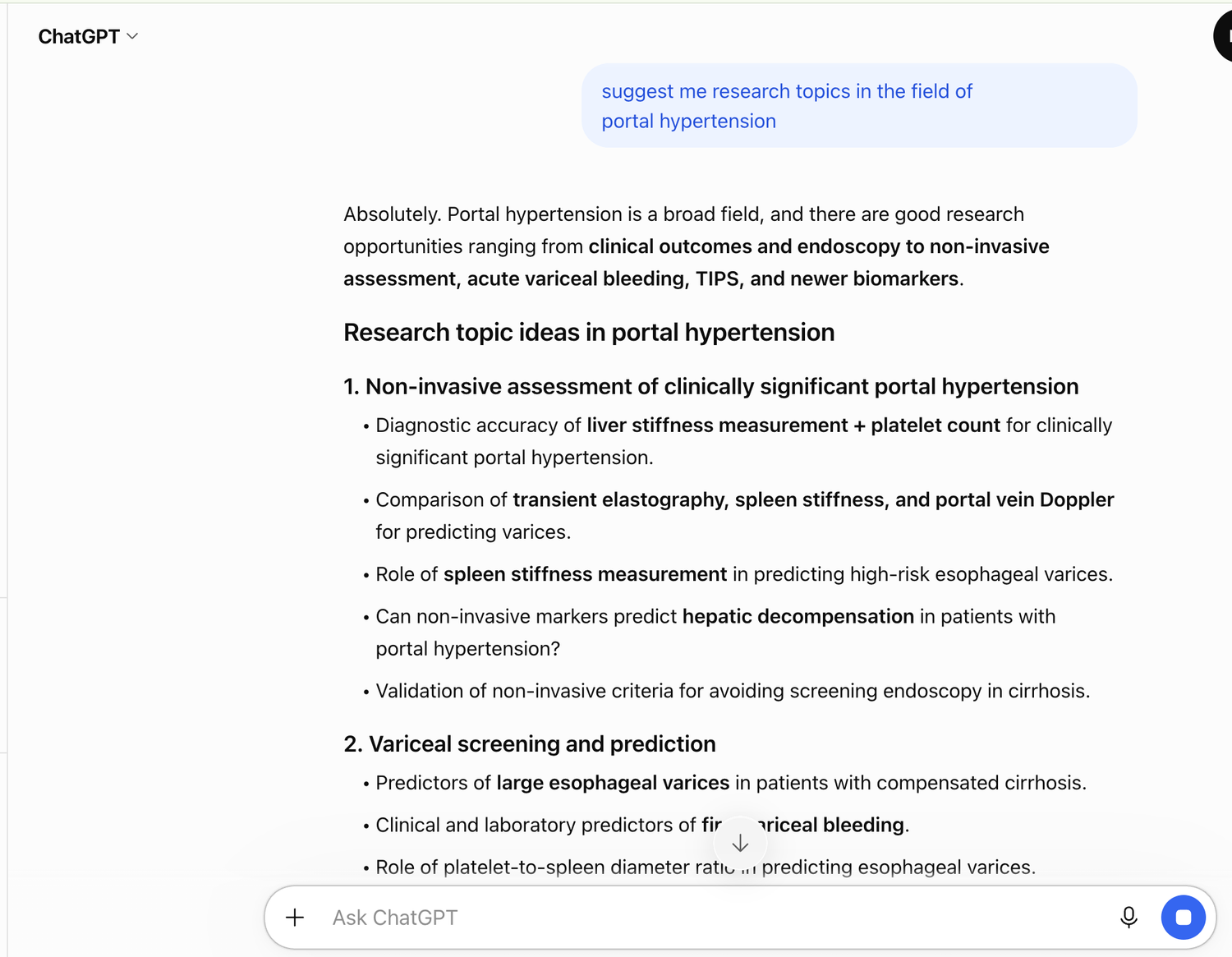
You asked ChatGPT for topics, and you couldn't tell which ones were any good.
Your supervisor said "bring me some ideas," and you're not sure what counts as a good one.
Your thesis topic still says "TBD," and the deadline hasn't moved.
If you nodded at two or more, the problem isn't your intelligence.
You were taught HOW to do research, not WHAT to research. Reading more gives you information, not direction. A senior gives you their idea, not yours. ChatGPT gives you a list you can't judge. What's missing is a process.
Here's How It Works:
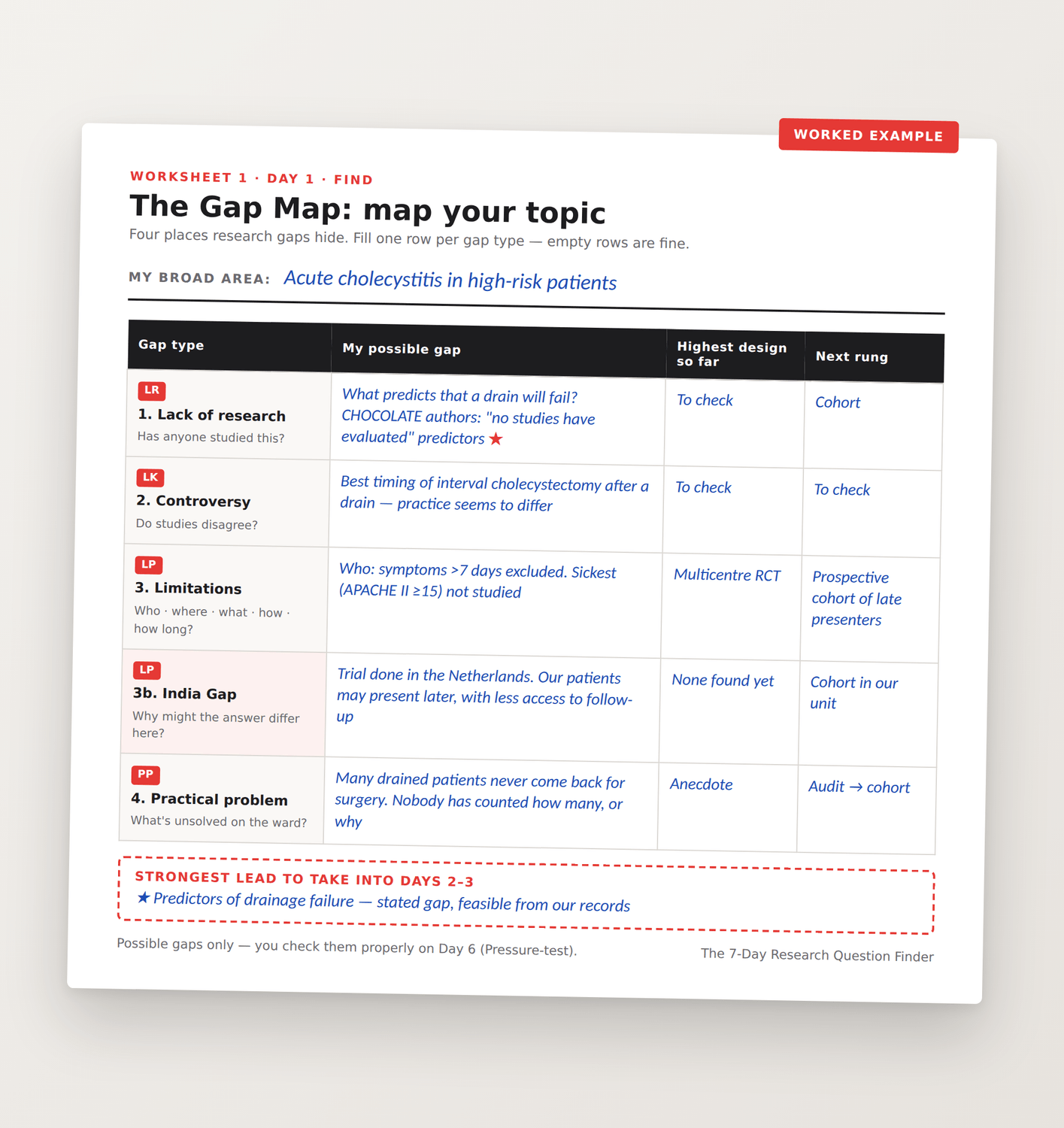

FIND the gap
(Days 1–4)
Almost every gap is one of 4 types: nobody has studied it, studies disagree, earlier studies fell short, or it’s still a problem on the ward. You'll also learn to mine them from the limitations sections most people skip.


FORMULATE the question (Day 5)
Turn a rough gap into one well-scoped PICO question, matched to a study design you can actually do.

PRESSURE-TEST it
(Day 6)
Check it before your supervisor does: Is it worth asking? Can I do it? Has it already been done?

PRESENT it (Day 7)
Build a one-page summary to take to your supervisor and refine together.
Backed by the Do-the-Work Guarantee: finish the Day 1–6 worksheets, and if you don't have at least one candidate research question, you get a full refund.
Watch the method on a real paper
One landmark trial. Three candidate questions. About ten minutes. These are starting points, not confirmed gaps, and checking them is what the Pressure-test step is for.
Can't I just ask ChatGPT?
You've seen this before.
Ask for "10 research topics in cardiology" and you get a list, with no way to tell which topics are already answered, which are feasible in your hospital, or which are worth your supervisor's time.
In this course, AI works inside the method. On Day 0 you set up your own AI research assistant. It knows your role, your hospital and your timeline, and it reads only the papers you give it.
Then it takes the clerical work off your plate:
AI handles:
pulling exclusion criteria,
limitations and "future research" lines from your papers, with exact quotes
filling your extraction sheet
drafting your PubMed search,
PICO question and
One-Pager
You keep:
deciding which gaps matter
choosing your question
judging feasibility with your supervisor
You'll also learn the guardrails: check every quote against the paper, never let AI decide whether your question is new, and keep patient data away from it.
Works with a free Claude or ChatGPT account. A paid plan is faster if you’re uploading many papers at once.
What's included?
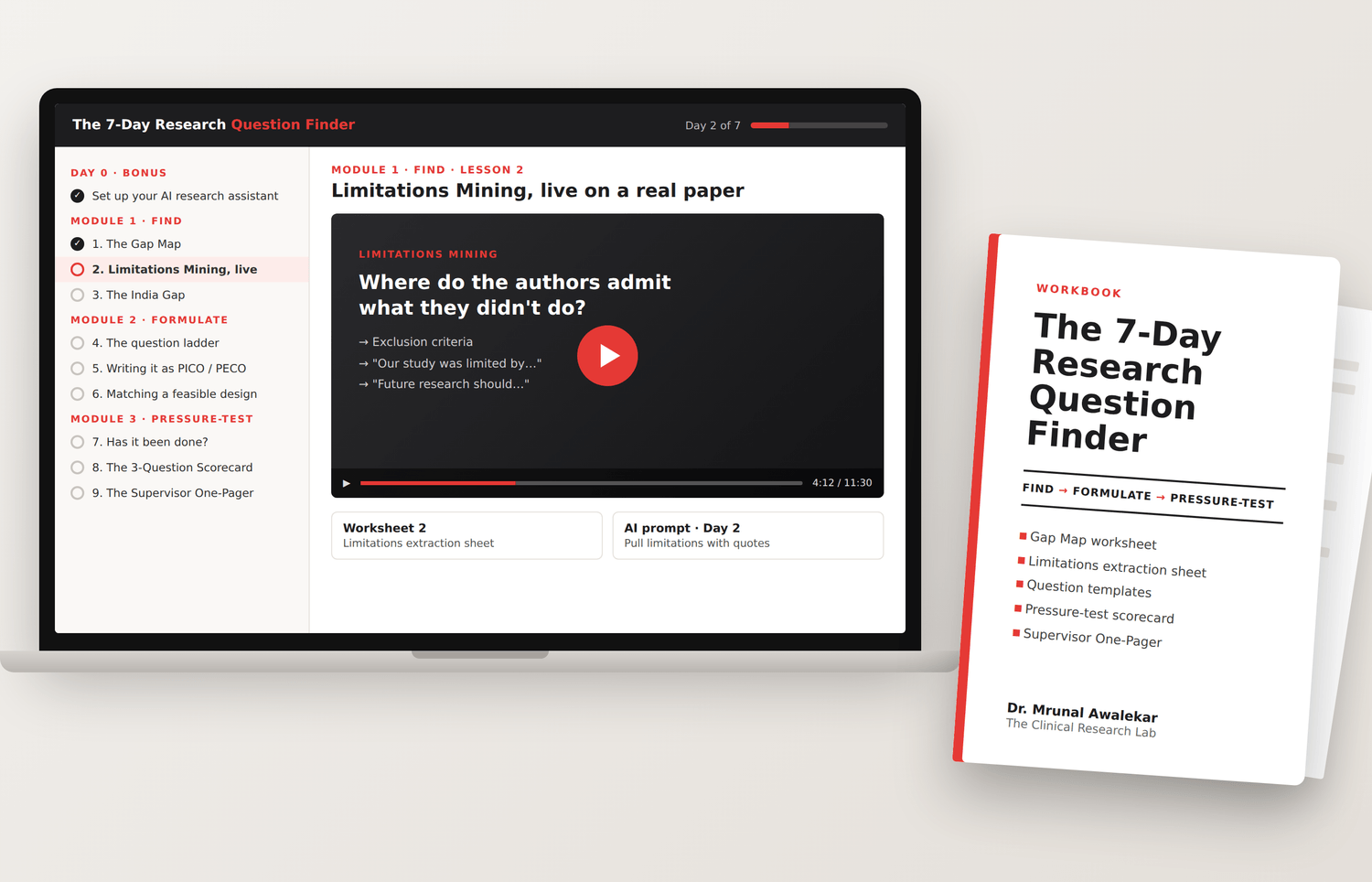
Day 0: Your AI research assistant. A 20-minute setup that makes Claude or ChatGPT work on your topic, your papers and your hospital.
Module 1: FIND. The Gap Map, Limitations Mining on a real paper, and the India Gap.
Module 2: FORMULATE. The question ladder, PICO/PECO, and matching your question to a feasible design.
Module 3: PRESSURE-TEST. A 20-minute search check, the 13-check pressure test, and the Supervisor One-Pager.
The complete workbook: Gap Map worksheet, extraction sheet, question templates, scorecard and One-Pager template, with worked examples.
Lifetime access. Reuse it for every project.
The Do-the-Work Guarantee: Complete the Day 1–6 worksheets. If you don't finish with at least one candidate research question, email us your completed worksheets within 14 days of purchase for a full refund.
What the 7 days look like
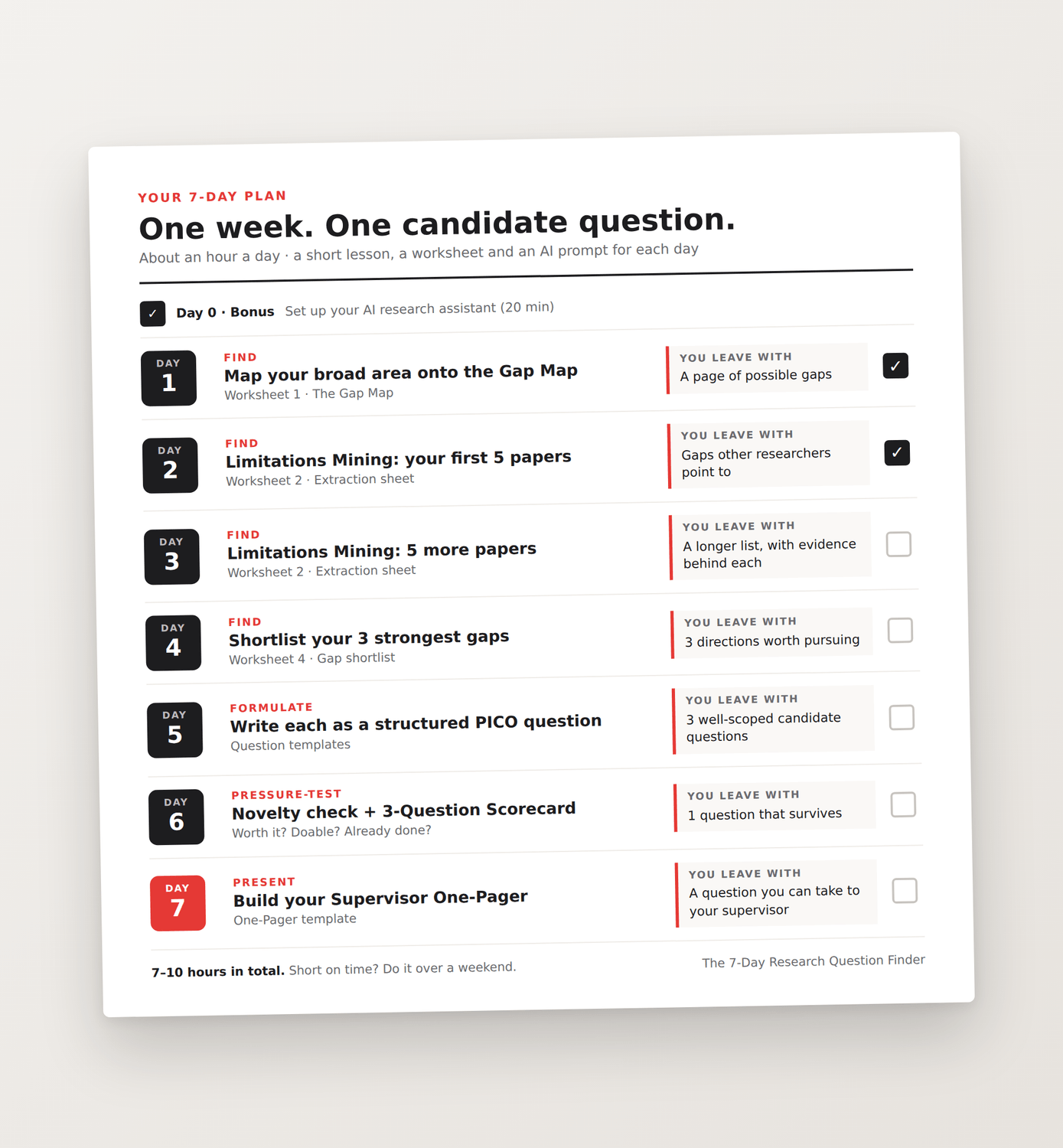
Day 1: Map your broad area onto the Gap Map
Days 2–3: Limitations Mining on 10 recent papers
Day 4: Shortlist your 3 strongest gaps
Day 5: Write each as a structured question
Day 6: Pressure-test and pick 1
Day 7: Build your Supervisor One-Pager
Small note: About an hour a day, 7–10 hours in total. Short on time? Do it over a weekend.
Is this for you?
For you if: your thesis topic is undecided · you're a student or intern who wants to start research · you're a doctor, fellow or consultant who wants a structured way to find your next project · you're faculty guiding trainees to topics
Not for you if: you want a guaranteed publishable topic handed to you · you already have an approved question · you want a full stats or study-design course (the free ICMR course covers that) · you can't give it about an hour a day for a week
Why I built this
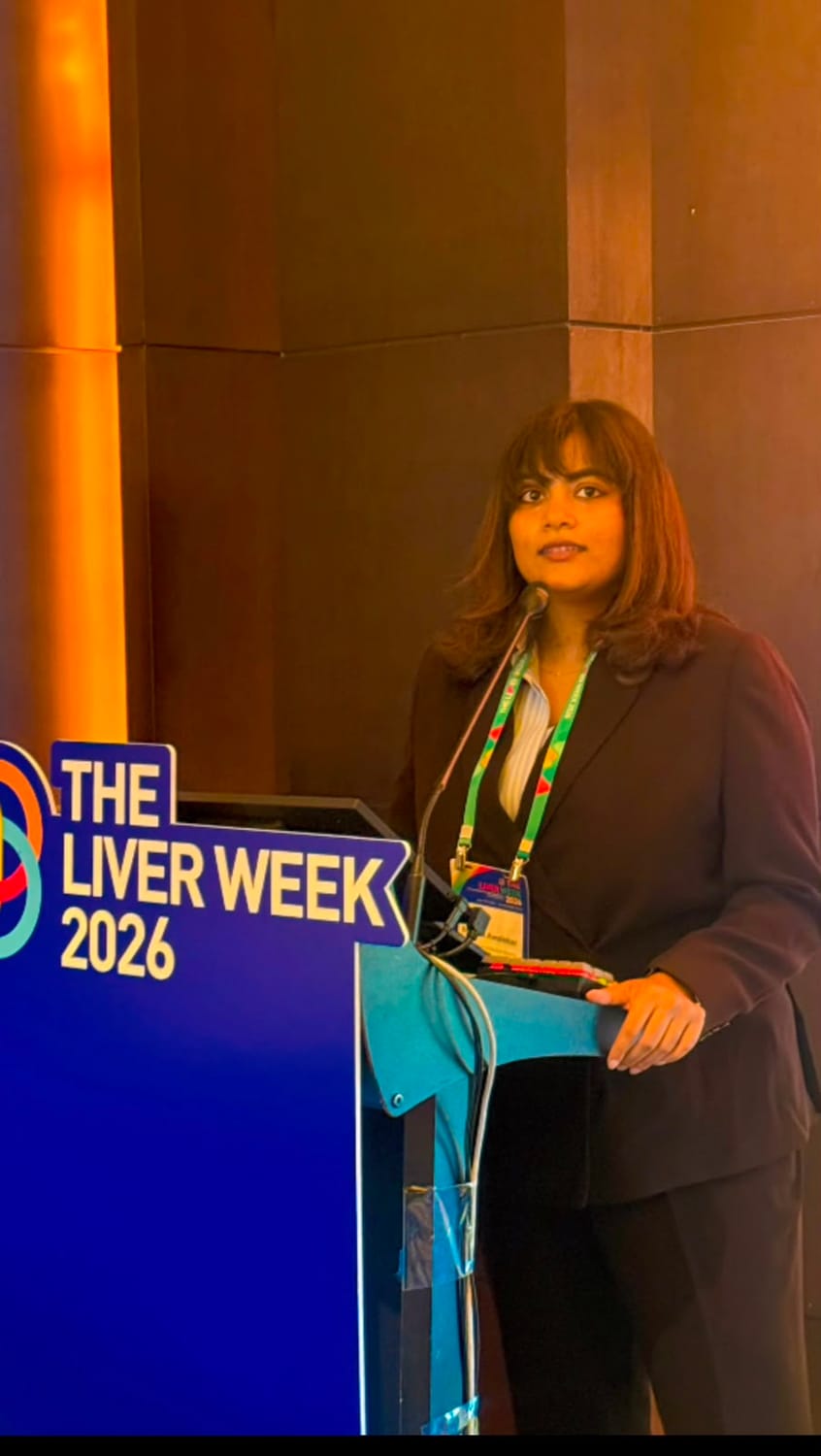
I'm Dr. Mrunal Awalekar, a consultant in GI/HPB and liver transplant surgery in Mumbai. I hold an MCh in Surgical Gastroenterology (Gold Medal). I did my thesis because it was required. What got me through was professors who held me accountable.
Based on that thesis, I have travelled on fully paid trips to Japan and South Korea, twice each. Both those experiences have completely reshaped the direction of my life. I have networked and befriended the top surgeons in my field and upcoming doctors from all over the world.
The year after sixteen years of training looked completely different because of it.
Research opened doors I didn't know existed. But the hardest part was never the statistics or the writing. It was the start: figuring out what to study.
Now, as an Assistant Professor, I watch capable residents lose months at exactly that step. Nobody teaches it. So I built a method for it.
Still Not Sure if This is For You?

No research experience needed
Built for medical students and first-year PGs

Free AI accounts work
Claude or ChatGPT; a paid plan is just faster

7 days, not 7 months
A one-week sprint, one step a day

You don't need your supervisor's idea
Take them your own question, on one page

About an hour a day
7–10 hours in total, or one weekend

Works in any specialty
The method is about reading papers, not your field
Frequently Asked Questions
No. That course teaches how to do research. This teaches the step before it: deciding what to research.
You'll get a list with no way to judge it. Here, AI works on your own papers and does the clerical work, and you keep the judgement.
No one can promise that. You'll have a literature-backed question and a one-page summary, which is a much stronger start than a blank page.
Yes. That's who it's designed for.
Lifetime
© 2026 The Clinical Research Lab
This site is not a part of the Facebook website or Facebook Inc. Additionally, This site is NOT endorsed by Facebook in any way.
FACEBOOK is a trademark of FACEBOOK, Inc.
Not ready to start the sprint?
Get the free Gap Map: the 4 places research gaps hide, and how to spot them in any paper in 10 minutes.
Free · No spam · Unsubscribe anytime